

On Pilgrimage to Maletsunyane: How a Lesotho Braai Festival Fired My Love for the Free State
Every year, as the first chill creeps into the air and the land seems to hold its breath before winter, I feel an undeniable pull toward the mountains. It’s not escapism or some item on a bucket list, this tug is something primal, a call that echoes back through generations, drawing me inevitably to my homeland and rooting me in the soil of my paternal ancestors, ba ha Mopeli from Lesotho. The source of that pull is always the same, the powerful roar of Maletsunyane Falls in Semonkong, Lesotho, a place where the land itself seems alive, where my family’s stories and my own childhood memories are woven into the mist. Here, in the highlands, there’s a sense of belonging that’s hard to describe until you’re ankle-deep in mud, hair damp from rain, heart beating in time with the pulse of the falls.
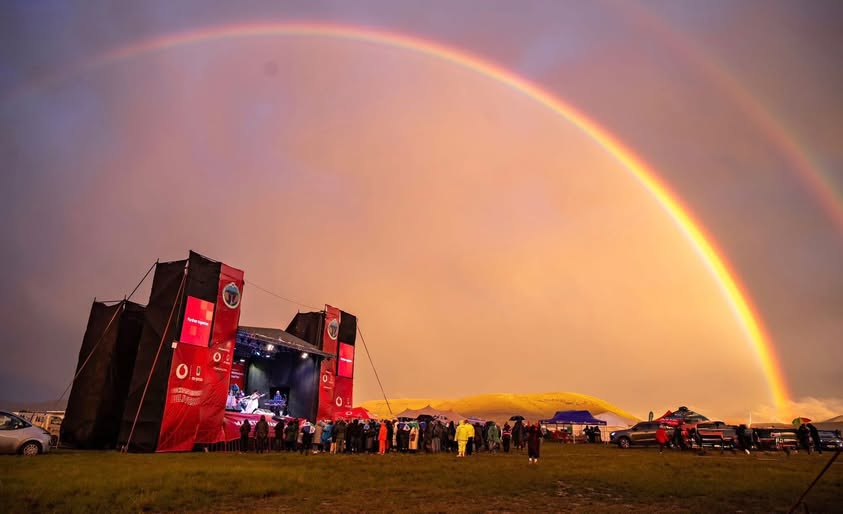
And every year, the Maletsunyane Braai Festival transforms these misty mountains into something electric. The air fills with laughter, music, and the irresistible aroma of meat sizzling on open flames. For the locals, and for us who return, it’s more than a festival, it’s a ritual, a coming together that reaffirms our shared identity. The mud on your boots becomes a badge of honour, the kind of thing you wear with pride, because it means you were really there, part of this living, breathing patchwork of connection that only happens in a place so raw and wild. The festival is a space where boundaries dissolve.
Someone hands you a steaming ladle of potjiekos from a battered three-legged pot, another offers a cold Maluti beer, and someone else tosses in their last onion so a communal stew can feed a few more. Every beat from the DJ, every clap of thunder from the falls, every clink of bottles is woven into a textile of shared experience. Here, the sense of community is built one muddy handshake, one shared meal, one new friendship at a time.
This year, though, something stood out in a way I hadn’t expected. Amid all the joyful chaos, I spotted a stall that glowed bright yellow through the drizzle and mud, not just with colour, but with energy. The Free State Department of Economic Development and Tourism (DESTEA) wasn’t content to be a passive observer; they were right there in the thick of things. Their “I Love Free State” campaign was more than marketing, it was a living invitation, extended by people who were genuinely excited to share their home region’s story. There were no empty speeches, no officials hiding behind velvet ropes. Instead, you saw real people, sleeves rolled up, chatting, laughing, and inviting festival-goers to experience the Free State firsthand.
This is what genuine tourism promotion looks like. DESTEA didn’t wait for potential tourists to stumble into the province. Instead, they brought the Free State to the heart of Lesotho, to the people for whom adventure and discovery aren’t just hobbies, but ways of life. As Thato Diaho Teedo Matsepe argued in a passionate online debate, “Free State tourism bought a stall at Maletsunyane Braai Festival to promote the Free State as a destination… People attending visit the different stalls for information, then they take pictures for visibility.” This isn’t just clever, it’s cutting-edge.
In a world where travellers crave authentic experiences, DESTEA offered something tangible: a memory. They handed out brochures to people with greasy, smoke-scented fingers. They took selfies with festival-goers against a backdrop of blazing yellow. They engaged in real conversations, sowing seeds of curiosity and connection that no billboard could ever hope to plant. That’s how you build a brand that lasts, one face-to-face encounter, one muddy, laughter-filled moment at a time.
But what truly struck me was the sense of partnership on display. Right next to DESTEA’s vibrant stall was Phela Moya Tours and Travel, the Free States very own travel agency local business that stood tall and proud. Their presence wasn’t overshadowed by government involvement; it was amplified. They displayed their contact details boldly, inviting everyone to explore the Free State through authentic, grassroots tours. This is what a thriving ecosystem looks like: government and entrepreneurs working shoulder to shoulder, leveraging each other’s strengths to create opportunities and drive sustainable growth. It’s not about grand promises or bureaucratic jargon, it’s about real collaboration, rooted in the needs and dreams of the people on the ground.
This integrated, hands-on approach doesn’t materialise out of nowhere. It’s the result of vision, commitment, and leadership that understands the value of direct engagement. When MEC Ketso Makume announced the extension of Dr. Mbulelo Nokwequ’s contract as Head of Department until 2030, I felt a genuine sense of optimism. In a world where so many leaders are content to preside from a distance, Dr. Nokwequ stands out as someone who isn’t afraid to get his boots muddy.
Dr. Nokwequ’s journey is remarkable, not just because of the titles he’s held, but because of the way he’s bridged the gap between theory and practice. He began as a Research and Development Chemist at Omnia Fertilizer in Sasolburg, where he learned the importance of innovation rooted in real-world application. As a Senior Lecturer and researcher, he developed the analytical skills to make sense of complex problems, seeing patterns and solutions where others might see only obstacles. Now, at the helm of DESTEA, he brings a rare combination of academic rigor and practical experience. MEC Makume got it absolutely right, Dr. Nokwequ is more than an administrator; he’s a heavyweight academic with the resilience and vision to steer the Free State through changing times.
His policy expertise isn’t just theoretical. It’s grounded in evidence, in data, and in a deep understanding of the challenges facing small businesses. Since 2016, Dr. Nokwequ has been immersed in the realities of small business development, advocating for SMMEs not as an afterthought, but as the heartbeat of the province’s economy. As Acting CEO of the Free State Development Corporation, he’s been instrumental in connecting policy to practice, making sure that strategies don’t remain stuck on paper but actually translate into real-world support and investment. This is the kind of stable, thoughtful leadership that’s needed to drive lasting economic growth.
What gives me hope isn’t just the presence of leaders like Dr. Nokwequ or the energy of festivals like Maletsunyane Braai. It’s the way these elements come together, visionary public servants, passionate entrepreneurs, and engaged communities, all working in concert. They remind us that economic growth isn’t conjured from boardrooms or manifestos. It’s built, painstakingly, through muddy boots, shared meals, and honest conversations. It’s about people who are willing to show up, to listen, and to invest in the places they love.
As I stood under the brooding Lesotho skies this year, surrounded by music, laughter, and the endless promise of the highlands, I saw the future being built, not by accident, but by design. The Free State’s yellow banners weren’t just symbols; they were signs of a region determined to matter, to be seen and experienced on its own terms. That’s the kind of tourism, and the kind of leadership, that can truly transform a place from a stopover into a destination, from a region people drive through into one they return to, year after year, because it feels like home.
Dr. Nokwequ just gets it. He approaches tourism as far more than a side project or a box to be ticked, it’s integral to the vision he has for the Free State’s future. He understands that if tourism is truly going to thrive, it can’t exist in isolation. It has to be seamlessly interwoven with broader economic development, the nurturing of local talent, and the encouragement of entrepreneurs from every walk of life. At Maletsunyane, the “I Love Free State” stall wasn’t just a decorative gesture; it was a vivid example of strategy in action, where policy is no longer just theoretical, but alive and tangible. It was proof that the department’s work isn’t confined to boardrooms but is present wherever communities gather, even in the most unexpected places.
As I rolled up my muddy, rain-soaked tent, I realised that something inside me had shifted. There was a new lightness in my step, a renewed sense of energy that I hadn’t felt in a while. Standing there, surrounded by fellow adventurers and locals alike, it was clear that the Free State is not content to rest on its laurels or rely on past glories. With Dr. Nokwequ’s steady hand guiding the department, there’s a refreshing adaptability and a sincere commitment to listening to people’s needs. The team isn’t just talking about community, they’re out there, in the thick of things, meeting people where they are, whether that’s in city centres or in a muddy field next to the thunderous majesty of the world’s tallest single-drop waterfall.
That’s when the campaign’s tagline truly hit home. “I Love Free State” isn’t just a catchy slogan, it’s a living promise. Every bold choice the department makes, every initiative that puts communities and local businesses first, is amplified by a vibrant #Summercampaign that’s catching fire online. The province is slowly but surely transforming into a destination with its own heartbeat, a place defined not just by its landscapes, but by the warmth of its people and the strength of its connections. Visitors aren’t just passing through; they’re drawn into a tapestry of adventure, genuine hospitality, and shared memories that stick with you long after you’ve brushed the last bit of Lesotho mud off your boots.
I came here searching for something, maybe a spark, maybe a sense of renewal. But what I found was more powerful: hope. Hope rooted in the vision of a province investing in its people, celebrating its culture, and building a future with open arms. Watching my home rise up with such determination and joy, right in the heart of this festival, was a reminder that real change is possible. Sometimes, it’s not just the scenery that nourishes your soul, but seeing your own community come together, daring to dream bigger and reach higher. That’s the kind of hope that lingers, long after the tents are packed away.
Disclaimer: Thabang Mokoka writes in his personal capacity
🔴Central News Weekly Edition | Issue 121 Download the Latest Print and E-Edition | Matlala Claims Demanded R1m in Cash Woolies Back During Shocking Testimony🔴
Download Here:
Direct PDF File Here:
https://centralnews.co.za/wp-content/uploads/2025/07/Central-News-Issue-114-1.pdf
Read all our publications on magzter:
https://www.magzter.com/ZA/Central-News-Pty-Ltd/Central-News/Newspaper/All-Issues
Central News also offers Sponsored Editorial Content, Podcasts , Radio / Social Media Simulcast, Video Production , Live Streaming Services, Press Conferences, and Paid Interviews (Video/Audio) etc.
We guarantee exceptional exposure, reach, and engagement, with an excellent return on investment.
Advertisement:
To place your advert on our platforms (Print Newspaper or Digital Platforms) : Please email : sales@centralnews.co.za
For Business Related:
business@centralnews.co.za
Newsroom:
Send your Stories / Media Statements To: newsroom@centralnews.co.za
General Info: info@centralnews.co.za
Office Administrator:
admin@centralnews.co.za
Whatsapp / Call: 081 495 5487
Website: https://www.centralnews.co.za
Social Media Platforms (@centralnewsza) : Linkedin, Facebook, Tiktok, Twitter, Instagram, Youtube